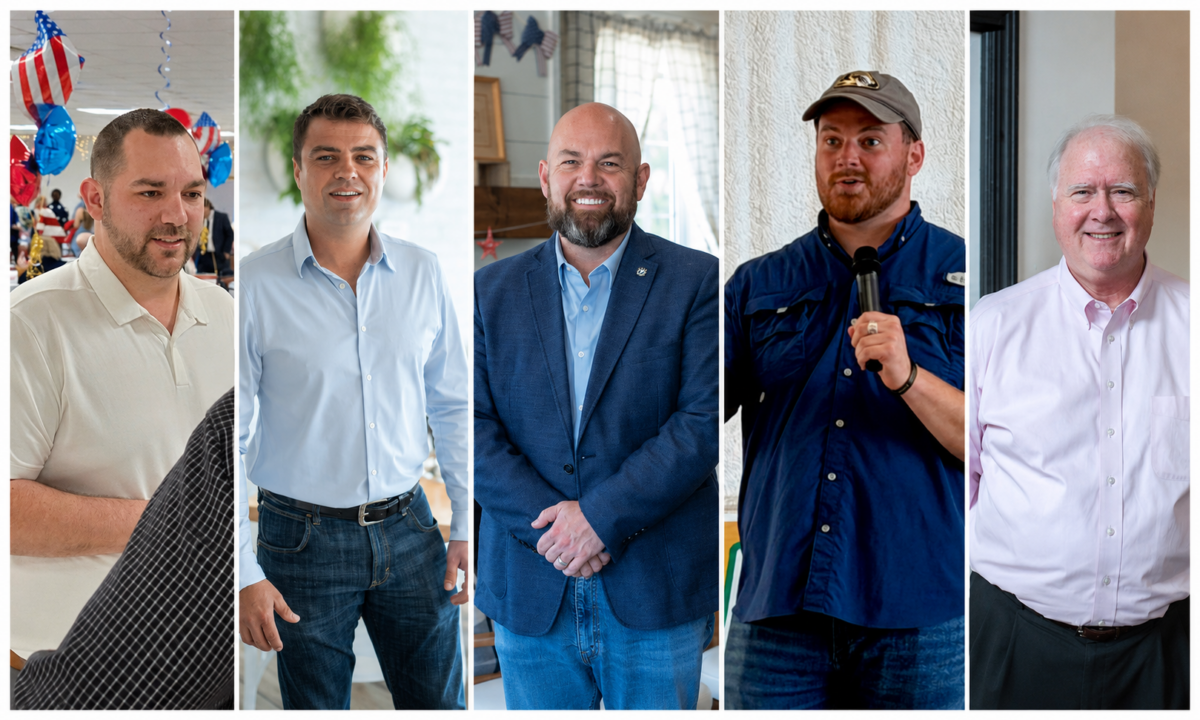
MARYVILLE — At a shrimp boil on a farm south of town July 1, Missouri Soybean Association President Casey Wasser stood before a crowd to explain why Kansas City Councilman Nathan Willett is the only candidate the association has endorsed in the race for Missouri’s 6th Congressional District.
He cited Willett’s curiosity — the questions he asked the association’s board about agriculture — and a phone call Willett made before he was a candidate, when Kansas City was preparing to install a bike lane near the Cargill grain facility.
“He called our board members, said, ‘Hey, how many of you deliver beans to Cargill in Kansas City? They’re about to put bike lanes in the main lane that delivers beans. Do you think that’s a good idea?’” Wasser said. “We said, ‘Absolutely not.’”
Willett, a high school math teacher from the Kansas City suburbs, is just one of five candidates working to prove they understand rural Missouri in the crowded Aug. 4 Republican primary to replace retiring U.S. Rep. Sam Graves.
Conservative radio host Chris Stigall, who was endorsed by Graves, says he has put “a few thousand” miles on his odometer crossing the district’s 33 counties, telling voters his first goal in Washington would be a seat on the House Agriculture Committee.
He also plans to keep Graves on board as a consultant on agriculture.
“He’s well respected and well plugged into the agriculture community,” Stigall said. “So he will be my go-to source on a lot of agriculture issues in particular.”
Also on the ballot are Jim Ingram of Kansas City, Cody Oshel of Maryville and Nathanael Schultz of Bowling Green, the only candidate who lives on a farm.
The winner will face the survivor of a three-way Democratic primary — Josh Smead of Liberty and Kansas City residents Scot Pondelick and Matt Levine — and Libertarian Andy Maidment of Kearney in November.
Missouri’s 6th Congressional District accounts for over a third of the state’s agriculture sales, according to the U.S. Department of Agriculture, with over 27,000 farms of which 94% are family operations.
But issues of agriculture, rural healthcare and public schools have at times taken a backseat as Willett and Stigall spar over Graves’ endorsement and who is the staunchest supporter of President Donald Trump.
Graves announced his retirement March 27, less than a week before the March 31 filing deadline, and endorsed Stigall as his successor in a social media post on the day filing closed.
Willett responded with a social media post accusing Graves and his “anti-Trump” political consultant, Jeff Roe, of trying to “hand-pick the next person to come after him for the next 26 years.”
Roe, whose consulting firm is running Stigall’s campaign, drew Trump’s ire after he worked on the presidential campaign of Florida Gov. Ron DeSantis.
The spat came up in a candidate forum hosted by the First Federated Republican Women’s Club of Clay County in June in which participants were instructed to avoid “personal attacks” and “negative campaign questions.”
Willett repeated allegations that Graves and Roe “hand-picked” Stigall, pointing to Stigall’s campaign announcement landing the same day as Graves’s retirement.
“(Graves) announced it within the Wall Street Journal. He didn’t announce it to North Missourians. He announced to the DC establishment that he was retiring,” Willett said. “That is unacceptable and un-American.”
Stigall responded by going on the offensive, characterizing Willett as a career politician who dropped a bid for the state senate for a flashier opportunity.
“I’m the only candidate here running for Congress and only Congress,” Stigall said. “I was not running for another office only to then switch and run for this office later. I always wanted to run for only this office.”
The dispute is being broadcast with six-figure ad buys, according to The Independent’s tracking of broadcast ad spending.
A pro-Stigall political action committee called Come and Take It PAC has spent $559,420 on ads, according to data from the Federal Communications Commission, including one portraying Willett as “woke.” The PAC has also used direct mail and social media advertising and had spent $974,315 opposing on the race as of Friday, Federal Election Commission records show.
An ad paid for by Willett’s campaign, which has spent $95,971 on broadcast ads, questions Stigall’s loyalty to Trump. Stigall’s campaign has spent an additional $277,105 on ads. The only other candidate who has purchased ads is Jim Ingram, who has spent $1,725.
With the race’s two best-funded candidates attacking each other, Ingram, Schultz and Oshel are hoping voters tire of it.
“Willett and Stigall are going to beat each other up to death,” Ingram told The Independent. “And I’m going to rise to the top because they beat themselves up with all the bad press about both of them out there. People don’t like it.”
Chris Stigall
As a conservative talk radio host, Stigall has spent two decades talking about politics. Aside from a two-year stint working in Graves’s office in the early 2000s, he has stayed away from policymaking himself.
He says the pandemic changed that.
“The COVID era really alarmed me, angered me in a way I hadn’t felt before,” Stigall told The Independent. “I just saw a government that felt like it was weaponized against the people: a lot of forced closures of businesses and churches, school surveillance, censorship, forced shots and mandates.”
Much of the conversation around Stigall’s campaign has centered on how he entered the race — and on allegations that Roe’s firm went looking for Graves’ replacement before voters knew the seat was open.
Senate President Pro Tem Cindy O’Laughlin, a Republican from Shelbina in her final months in office, said at a Macon event announcing her endorsement of Stigall that she “was asked to consider” running for Graves’ seat and went on a “research expedition to D.C.” with Aaron Baker, a vice president at Axiom.
O’Laughlin posted on her personal Facebook page that she was in Washington on March 19 — eight days before Graves announced his retirement.
Stigall told The Independent that he learned about Graves’s retirement “maybe second to last week of March or the last week of March.” And since then, he has been trekking across the state making appearances throughout the district.
“This is not a promotion for me. It is not a career-ladder climb for me,” he said. “This was a very intentional departure from my career of 25 years to jump into something that I felt I could best do at this time in history for a window of time, and then come back home.
“Will I do it for 26 years?” he said, alluding to Graves’s career in Congress. “No, I will not. I can promise you that.”
Another thing separating him from the congressman is his experience in communications.
“He was a workhorse, not so much a show horse,” Stigall said of Graves. “I like the workhorse element of him. I’d like to be that too. But I do think in 2026, it’s important to be forward-facing.”
Stigall’s goal is to visit all 33 of the district’s counties twice a year when he is home. And when he is in D.C., he will communicate with the district through social media.
But a key person he wants to connect with is Trump, saying he “needs backup in Congress right now.” The attack ads questioning his loyalty are “disingenuous” and “deceptive,” he said.
“There’s never been any daylight between me and the White House since the president’s been in office,” Stigall said, noting that he has interviewed Trump on his radio show on seven occasions.
Asked whether some of Trump’s executive actions amounted to abuses of power, Stigall consistently defended the president.
“It is almost as though Congress won’t do their job. I don’t know that it’s so much that they’re being usurped as they won’t do it,” he said. “So a strong executive has filled a vacuum where the legislative has just abdicated the responsibility.”
Trump has not made an endorsement in the race, but Stigall said in June he “believes that it will come.”
Nathan Willett
Willett, who had filed to run for the Missouri Senate but shifted gears after Graves’ retirement announcement, has emphasized his record as a conservative voice on the Kansas City Council, describing himself as a “doer” with practical political experience.
During the Maryville event, Willett pointed to what he describes as his role in securing $25 million for a new building to house the Northland Workforce Development Center in his council district, which offers courses including agricultural sciences, construction technology and culinary arts and is set to expand.
Instead of providing college loan relief for college, Willett said, the federal government should offer incentives for students to pursue careers in the skilled trades or as first responders or nurses.
“That sets up the next generation to succeed, to be able to go out and earn a good quality living and not be relying on the federal government or some kind of government assistance,” Willett said.
Willett said he supports the elimination of the U.S. Department of Education, moving a few operations, such as special education, to other agencies. The Trump administration announced plans last month to move most of the Office of Special Education and Rehabilitative Services to the U.S. Department of Health and Human Services.
For Missouri farmers, Willett promised to fight against excessive regulations but said he thinks Trump’s tariff hikes will eventually open up new markets to U.S. agricultural exports.
“You’ve got to try to prioritize people in production over what D.C. wants you to do,” Willett said.
Willett’s agriculture steering committee includes Brian Klippenstein, who led U.S. Department of Agriculture transition teams at the start of both of Trump’s terms, and former Missouri Farm Bureau President Blake Hurst — both of whom appeared at the Maryville event. Both have long fought health and environmental regulations they say hinder farmers.
Hurst has appeared in videos for the Modern Ag Alliance, a lobbying group founded by Bayer in 2024, defending the safety of glyphosate — the active ingredient in Roundup and the subject of thousands of lawsuits alleging a link to cancer, which the company disputes.
Before joining the USDA, Klippenstein was executive director of Protect the Harvest, a now-defunct group that advocated for farmers against animal rights organizations like the Humane Society of the United States.
To relieve farmers from high input costs, Willett said the U.S. should invest in domestic fertilizer production, reducing dependence on imports from the Middle East.
Willett said he supports congressional term limits, adding that Graves, “especially toward the end of his term, has lost touch with a lot of north Missourians.”
If elected, Willett said he envisions spending “a decade max” in Congress.
“My retirement is in the education system here,” Willett said.
Nathanael Schultz
Schultz entered the race on the last day of candidate filing ready to “buck the system” with controversial views, like support for a federal ban on abortion and supporting the “Second Amendment to the point that we should all have machine guns.”
He was upset with Graves’s speedy endorsement of Stigall yet encouraged that he could be part of a “new generation” of GOP politicians.
Alongside family members, Schultz has a stake in multiple small businesses, including a towing business he runs alongside his brothers and a fire and water restoration company.
With his livelihood tied up in the economy of small-town Missouri, he says federal officials are ignoring the pressure on small towns.
“It just seems like more and more pressure is getting applied (to small towns),” he said. “We have big farms and the government has been involved in that, but you’ve got the surrounding and supporting economies that I feel like have zero representation from a federal level.”
Schultz supports current efforts from the federal government rolling back regulations on agriculture, saying that he would like to see almost “zero regulation” when it comes to farming. He also believes the government should limit crop subsidies, with some exceptions.
Schultz raises livestock and grows crops on his acreage, not for commercial purposes but to help feed his family of six.
This back-to-roots mentality is also present in his view on healthcare, saying he trends “on the crunchy side” with an emphasis on natural remedies and nutrition over pharmaceutical interventions. Trump’s selection of Robert F. Kennedy, Jr. as Secretary of Health and Human Services is “one of the greatest things Trump has done,” he said.
In the past year, major medical associations have spoken against Kennedy’s proposals, like his attempted overhaul of the pediatric vaccination schedule, and called for his resignation in a joint letter in September.
Schultz is a supporter of the president, but he is not vowing a blind allegiance.
“We need someone who can handle making hard decisions rather than saying, ‘Okay, I’ll go along with whatever (Trump) says’ and be a bobblehead essentially,” he said. “I believe I am that person.”
Jim Ingram
Ingram hopes his “maturity” and extensive experience in business will garner support of voters tired of career politicians.
He filed his candidacy more than a year prior to his competitors, telling voters at a Clay County forum he got the “stink eye from everybody” when he dared to challenge Graves, who had not yet announced his retirement.
“Political consultants would not talk to me because I was running against an incumbent,” he said.
His political journey began with an idea, one he calls “Ameristralia.” In a 370-page book, he proposes that Australia, Canada, Greenland, Iceland, New Zealand, the United Kingdom and the United States — all English-speaking countries — form into one nation.
“I am just suggesting we add those countries to the United States to make our economy larger, able to defend ourselves more, and it would give us more power,” he said.
The two pillars of his campaign are “term limits and a balanced budget,” holding up what he sees as key responsibilities should he be elected.
Other ideas include reforms to the U.S. Constitution to make election protocols consistent across states. He would also like to mandate that more entities, like government agencies, limit written communications to only the English language. Driver’s license applications, websites and the like should all be in English, he said, incentivizing more people to speak the language.
He is the only candidate in the race to not receive an endorsement from Missouri Right to Life, an anti-abortion advocacy group.
Ingram considers himself anti-abortion but does believe the procedure should be available in certain situations, like rape, incest, fetal anomolies or to protect the health of the mother.
Cody Oshel
Oshel told The Independent access to rural healthcare and keeping farms within families would be some of his top priorities if elected to represent the 6th district.
Healthcare, he said, is “the backbone everything ties into — agriculture, every livelihood in our communities.”
Missouri has lost 21 hospitals in the past decade, according to the Missouri Hospital Association. In the 6th District, that includes Signature Psychiatric Hospital in Liberty in 2024 and Audrain Community Hospital in Mexico in 2022.
“People from up north either have to go to Columbia or Kansas City,” Oshel said. “And if you’re living in these rural communities, you don’t want to drive in those places, (especially) if you’re an older person.”
While Oshel said he is “not a big fan” of the Affordable Care Act, he supports an extension of the enhanced premium tax credits that expired in January to help people afford health insurance.
Oshel’s father, who was diagnosed with leukemia this past year, travels an hour and a half twice a week to get treatment, Oshel said. That’s on top of adding a rural mail route to his work as a mechanic to help cover the cost of his care.
Oshel said the federal government bears some responsibility for helping rural hospitals and clinics keep their doors open.
“Government decided to get into the healthcare business, so it’s their responsibility to fix it,” Oshel said.
Oshel, a former pastor currently leading national partnerships for the financial services organization Thrivent, said he is passionate about wealth transfer — especially when it comes to keeping farms within families.
Inheritance and estate taxes shouldn’t prevent farming families from passing their land to the next generation, Oshel said.
“I always believe we should keep Uncle Sam out of the wealth transfer,” he said.
If elected, Oshel said he would also support restrictions on land sales to “adversary countries” like China.
While he said property owners should be free to sell land to foreign buyers, there should be greater transparency about buyers’ origins, preventing them from hiding behind shell companies.
“We need to protect our land,” Oshel said, “because once our land goes away, it doesn’t come back.”
This story was originally published by the Missouri Independent and is republished here by the Rocheport Times with permission under the terms of the Missouri Independent republishing guidelines. Read the original story and view its photos at missouriindependent.com.
The Missouri Independent is a nonprofit, nonpartisan news organization and a member of States Newsroom. Its work is licensed under Creative Commons CC BY-NC-ND 4.0. The lead photograph above is credited to Missouri Independent and republished under the same terms; see the original story for the rest of its photos.
Leave a Reply